Friday, July 12, 2019

Fixing A Clogged Drain


When it comes to being handy around the house, there are two areas where many of us tend to shy away — electrical work and plumbing. While anyone who’s ever received an electric shock understands the risks of doing that type of work, basic plumbing is something just about anyone should be willing to take on.
Whether it’s a clogged sink, shower, bathtub, or toilet, before you pick up the phone to call a plumber, here are a few things you should try first.


Taking the Plunge

A good old-fashioned plunger is great way to loosen clogged drain pipes. Plungers come in multiple sizes — use a small one for sinks, showers, and bathtubs and a large one for a clogged toilet. Plungers work best submerged in water because this allows for greater suction. Plunge steadily, keeping in mind it may take a several attempts to successfully eliminate a blockage.
If you’re trying to unclog a double kitchen sink with a plunger, begin by closing off one sink with a stopper. This will prevent any liquid from splashing back once you begin plunging. Then fill the other side of the sink with enough water to cover the bell of the plunger and create a tight seal.


Plumber’s Snake and More

Another solution that doesn’t require using potentially harmful chemicals is a plumber’s snake. This long flexible wire with teeth along its outer edges can be used to dislodge hair, soap, grease, or anything else clogging the drain. If you don’t have snake on hand, a coat hanger may do the trick. You can also try using a wet and dry vacuum to suck out the clog. To do this, insert the nozzle directly into the drain.


Drain Cleaners

  • The natural mix: A mixture of vinegar and baking soda can be a convenient and effective non-chemical solution for unclogging drains. Pour 1/2 cup of baking soda into the blocked drain and then pour in 1/2 cup of white vinegar. Plug your drain and let it stand for at least 15 – 20 minutes, then flush with boiling water. Repeat if necessary.
  • The chemical solution: You’ll find a number of drain cleaning products available at your local hardware or grocery store. These come in a variety of strengths, so be sure to look for one that’s right for the type of drain you’re trying to unclog. These products specify a period of time for the chemical to “stand’ and then flush using hot water. Again, repeat if necessary. These cleaners are made of extremely strong and even corrosive chemicals. Be sure to follow directions closely and take the necessary precaution of using heavy rubber gloves and goggles.


Different Drains Require Different Approaches

If you’re unable to unclog a kitchen or bathroom sink with any of these methods, try removing the “P-trap,” which is located at the bottom of the drain pipe where it curves. Loosen the slip nuts at both ends of the pipe with a plumber’s wrench. Use the snake on the remainder of the drain pipe, then clean out any debris in the trap before reattaching it.
Turn off the electricity when attempting to unclog a kitchen sink that has an electric garbage disposal. Try using the vinegar and baking soda mix first to remove grease and trapped food. If that doesn’t work, you’ll want to try to one of the chemical solutions.
You may use any of these methods on a clogged shower or tub drain. However, you may need to disconnect or remove the internal stopper mechanism before you begin.
Using chemicals can be harmful to your toilet. First, try pouring 1/4 cup of dish detergent into the toilet bowl. Dish soap acts as a lubricant to help break up any residue. Then add boiling water and use a plunger to finish dislodging the clog.


The Bottom Line

Unless a foreign object has become lodged in a drain pipe, clogs tend to develop slowly over time. The accumulation of soap, grease, hair, and other detritus results in slow draining and even standing water. Regular cleaning and proper drain strainers can save you time and money.
Next time, before you call a plumber about a clogged drain, try these simple techniques. You’ll be surprised by how easy DIY plumbing can be.

article source:  By |May 29th, 2019

Friday, June 28, 2019

Scams In Real Estate To Watch Out For


The real estate industry is rife with scam artists, and millions of homebuyers, sellers, and owners fall victim every year.
The truth is, the more that real estate and its processes go digital, the more at risk our data, information and, most importantly, finances are as we go about these massive financial transactions in our lives.
It requires extra diligence on our part, as well as from the agents, lenders, title companies, and everyone else we do business with.
Are you considering buying, selling, or renting a home? Here are the scams you should watch out for — and how to spot them.

1. Wire Fraud

This is the big one, accounting for millions (potentially billions) in financial losses every year. It typically occurs with a single email hack. The scam artist gains access to just one email account involved in the transaction — a real estate agent, someone at the mortgage lender or broker’s office, an escrow officer, a title agent, or even a buyer or seller, and then monitors communications from there.
Once the closing date nears, the scammer sends a fake email — usually using spoofed email addresses very similar to those actually involved in the sale — asking the party to wire their funds (down payment, closing costs, mortgage payoff) using certain instructions. Little does the victim know, those instructions aren’t from a legitimate source, and their money is wired right into an offshore bank account never to be seen again.

2. Bait & Switch

This is the scam that sellers need to worry about. A buyer comes in with an above-market offer. The home is then switched to pending and no other offers are accepted. Weeks pass, and as closing nears, the buyer asks for an extension and the seller grants, knowing the high offer they’ll be getting in return. In the meantime, the seller is stuck paying the mortgage payment, taxes, utilities, etc., while the buyer keeps spinning their wheels.
After a few rounds of this, they come back with an excuse for why their original offer will no longer work, instead offering a low-ball bid. Frustrated by the extra costs and hesitant to re-list the home and start from scratch, the seller accepts, losing out on thousands of dollars and months of time and hassle.

3. The Phantom Listing

This one typically involves a property in which the owner is out on vacation, away for business, or only a temporary resident. A scam artist gets wind of the home’s temporary vacancy, markets the home to on-the-market renters. They might even bill it as a steal — “Just XX price for this pre-furnished and fully decorated property!”
They then close the deal, often asking for several months of rent in advance (plus deposits, fees, etc.). By the time the money has exchanged hands and you’ve moved in, the real owner comes back to find their home occupied by an unwanted (and illegal) tenant.
This can also happen with out-of-town homebuyers. Their “agent” sends them photos or video of a home — one that’s not actually available — and asks them to wire earnest money and option fees in order to nab the property. Thinking this is the norm when buying from out of town, the buyer complies, only to lose thousands of dollars in the process.

4. Duplicate Listings

In addition to fake and phantom listings, there’s also a scam involving duplicate listings. Here’s how it works: Scammers copy a legitimate rental listing, post it on other sites (Craigslist is a big one), and drop the price for a few hundred dollars to get some attention. They then ask the renter to wire their security deposit, first month’s rent, and other fees in order to hold the property. Once the money is sent, they (and that money) disappear into the night, never to be seen or heard from again.

5. Fake Agents & Real Estate Lawyers

Fraudsters are also known to impersonate real estate attorneys and agents, too. They might choose a legitimate professional and then mock up a website or profile using their identity, or they may create an entirely new persona out of thin air. Once they’ve got a potential buyer on the hook, they show them properties, help them find the right one, and then steal their deposits, escrow money, or closing costs with faux wiring instructions.

Red Flags to Watch for

Avoiding these and other scams is all about being diligent, reading your emails carefully, and vetting who you work with.
Specifically, you should:
  • Look carefully at each individual email address on a message, especially if it contains a request for money or financial data
  • Voice verify any wiring instructions or requests for money
  • Verify the license and credentials of your agent and real estate attorney
  • Be wary of any too-low-priced or pre-furnished/decorated homes
  • Research the property you’re considering using local appraisal district and property records
  • Use double-layer identification on your emails and make sure your vendors do, too
  • Don’t send financial documents over email; use a secure portal or folder instead
Most importantly, don’t send money to anyone unless you’ve verified who they are and what you are getting in return.
article source: By |June 13th, 2019

Wednesday, June 5, 2019

Use Less, Save More: Energy-Efficient Tips for Lowering Your Utility Bills


Save more moola for summer fun — try these savvy energy-saving tips, and ditch the exorbitant energy bills once and for all.
We all enjoy being warm and cozy in the winter, and cool as a cucumber in the summer — but the energy bills that keep us there can get out of hand quickly.  Luckily, home updates, inexpensive projects, and even minor changes in routine can create notable savings.


Hunt for an energy-efficient home

When my husband and I started our home search, we knew energy efficiency was a priority. Before we found a real estate agent, we carefully considered how many square feet we’d need to be comfortable as a family — and it wasn’t as much space as we’d thought.
House hunting was absolutely about finding a place that looked and felt like home, but we also kept in mind practical considerations. Updated windows, modern appliances, and a sufficiently insulated attic can have big impacts on home energy use.
We also found that some home features, such as cathedral ceilings and sun rooms, can increase energy costs. And if you’re home shopping in hot climates, keep an eye out for homes with cool-roof features to prevent the air-conditioning from working overtime.
Once we found a home we loved, we lined up a home inspector with a great reputation. Walking through the home alongside the inspector taught us a lot about our home’s energy efficiency. We learned how our insulation levels compared to standards in our region, and the age of major appliances and equipment in the home.
If your dream home doesn’t come with an energy-efficient water heater or updated windows, there’s no need to despair. Issues that show up during a home inspection give you grounds to negotiate with the seller.
In the end, our family of three chose a modern cottage (just under 800 square feet) in a great neighborhood with a large garage for hobbies and storage space. We get a lot of use out of our generous outdoor entertaining space and garage, while the modest size of our home keeps our monthly utility bills low. It’s a choice we don’t regret!


Assess major appliances and equipment

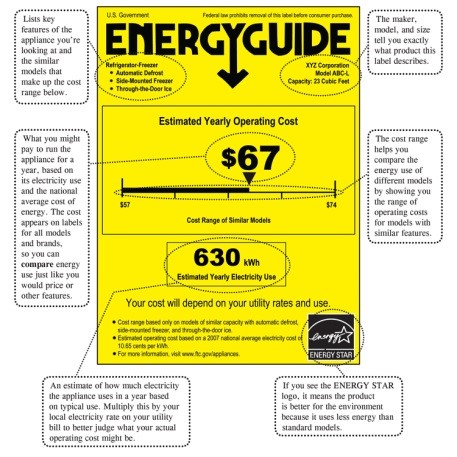
Shopping for efficient new appliances and equipment is easy, thanks to independent certification from Energy Star. Most modern appliances feature an Energy Star label that gives you a yearly estimated operating cost:


Image from the Federal Trade Commission.
Older appliances may not be as easy to assess, but you can use the U.S. Department of Energy’s appliance energy calculator to estimate how much energy they use.
With roughly half of all energy expenses going to heating and cooling, high-performing heating, ventilation, and air-conditioning (HVAC) equipment should be a priority for every homeowner. Overall efficiency, however, isn’t the only factor to consider when evaluating your heating and cooling system.
When we initially bought our home, the previous owners installed an oversized furnace. It might’ve been a great choice for a larger home, but not ours. The furnace would inefficiently short cycle during winter, ratcheting up our energy costs while causing excessive wear and tear on the furnace itself. When we replaced it with a model half the size, we saved a bundle on our monthly utility bill.


Try quick, energy-efficient fixes

Not a lot of dollars to put down on a new HVAC system? No problem. Not every move toward energy efficiency requires an expensive home upgrade.
There are all kinds of quick fixes that owners and renters can make to cut back on energy costs. Energy Star has simple money saving tips that anyone can put in place today.
Easy tasks, such as replacing weather stripping on a drafty front door, washing laundry in cold water, changing your ceiling fan’s direction, and using energy-efficient light bulbs, can all make an impact on your budget’s bottom line.


Seek expert guidance

Expert help doesn’t have to be expensive. Many local utility companies provide an energy audit, and they often offer them for no charge.
We recently scheduled this kind of assessment, and when they come out, they’ll give us free advice on how to lower our energy bill even further. As a part of their visit, they’ll update up to 20 light bulbs at no cost, increasing our home’s efficiency on the spot. They offer high-performance shower heads and other free perks, too.


Lower your utility bill — then save a little more

Energy-efficient upgrades provide a whole lot of bang for your buck. In addition to lowering your monthly utility bill or making your home more comfortable in extreme weather, you might also be eligible for tax credits, rebates, and additional savings. We updated our windows and replaced our furnace by using tax credits.
The number of programs offering additional savings can be overwhelming. Luckily, you can conduct some quick research online to ensure you’re not missing out. The U.S. Department of Energy’s tax credits, rebates, and savings database is a great place to start.

By Melanie Harding


Monday, May 20, 2019

Stop Cleaning Your House Wrong

It's that special time again. Time to throw open the windows, bust out a mountain of cleaning supplies, blast some Beyoncé, get into a zone, and start working on making your home spick-and-span.
But hold on, hasty home cleaner: Before you get started, we need to tell you how to clean. Yes, we really do. You probably think you know all there is to know—after all, you've been doing this all your adult life, right? But it turns out that creating a gorgeous, dust- and grime-free space is a lot trickier than it looks, especially if you're not hip to professional cleaners' sneakiest tactics.
So we did the dirty work for you. Here, we've rounded up eight ways you've been tackling spring-cleaning all wrong, according to the pros—and how to do it right.

1. Dry mopping

What's the best way to get all the dirt and crumbs out of the way before you wash down the kitchen or bathroom floor? Dry mopping (aka “dust mopping”) might seem to make sense, but you're better off busting out the Hoover. Trust the pros on this one.
Vacuuming removes two times more debris, says cleaning expert Donna Smallin Kuper. And you want as much debris as possible out of the way—otherwise it will just get spread all over your kitchen when you wet mop. And that will make getting rid of it the next time even harder.

2. Not emptying the vacuum receptacle

Before you dig out the vacuum for your spring-cleaning escapades, get rid of the evidence from the last time you cleaned. All of it. If your dust buster's canister or bag is more than half-full, empty it before you start sucking.
A too-full vacuum makes a much less efficient cleaner, meaning you might have to go over your living room two or three times just to remove your dog's latest layer of hair. Emptying the bag at the start (or if it gets too full midcleaning) means much less work for you.

3. Going rogue

Cleaning might not seem like a science, but it's certainly simpler if you treat it like one. If your lemon floor cleaner says you need only 1 tablespoon per gallon, follow that instruction. You'd be amazed (or perhaps not) how many people think more is always better.
“If more worked better, they would recommend more,” Smallin Kuper says. After all, it's in their interest to sell more product. So why would they tell you to save when they could tell you to splurge? Because their stuff is made to work a certain way.
Pay attention when you read (not skim) the manufacturer's instructions, and follow them closely to save yourself time, sanity, and money.

4. Using paper towels and rags

Ditch the paper towels—and don't use rags in their place.
Microfiber cloths are far more effective at removing dirt and grime than cotton cloths, and you can pick up these miracle workers in every shape and form—including gloves that fit over your hand for easy general-purpose dusting to varieties specifically designed for cleaning electronics or wood floors.
As a bonus, microfiber clothes catch dirt and dust (and even bacteria!) between their superthin threads, letting you clean most surfaces without the need for chemical cleaners. Of course, heavy-duty stains may require some additional work, but as a general rule you'll be cutting costs in your cleaning cabinet.

5. Not wiping down your light bulbs

Cleaning your old bulbs isn't just an aesthetic- or allergen-related requirement. It actually helps you keep your home cheery and bright—and your electricity bill under control.
Dirty light bulbs emit 20% less light than clean bulbs, Smallin Kuper says. And that's not just wasted light—it's wasted energy.
Before cleaning, make sure the lights are turned off (no shocking surprises here). Use a dry microfiber cloth to clean off your bulbs—water or cleaning sprays can affect the electronics—and enjoy the sudden rush of brighter light when you flip the switch.

6. Storing things in cardboard boxes

Boxing up your seasonal odds and ends? While it might be tempting to use the pile of leftover moving boxes accumulating in your garage, you need to a trip to the store.
One cleaning mistake Smallin Kuper frequently sees is “storing things in cardboard boxes in the basement, attic, or garage instead of waterproof, insect-proof plastic bins.” Mold, termites, or just dampness after a rainy spring can damage your precious belongings. Pick up some heavy-duty plastic boxes instead.

7. Not decluttering first

We see you eyeing that dust rag. Wait! If there's still a layer of clutter around your home, don't even think about cleaning.
If you don't pick up things first, you'll be making multiple passes through a room, putting toys on the couch to clean the floor, pushing them in the corner to clean the couch, then realizing the dirty toys left another layer of dust, which requires another quick cycle.
Make sure there's nothing out that shouldn't be visible. Only then do you have our permission to start cleaning.

8. Spraying the glass

Cleaning glass-framed artwork or mirrors? Here's a less-than-obvious tip: Make sure you're spraying your cleaner onto the cloth, not the glass itself.
“The cleaner can drip or spread into the frame and damage the artwork,” Smallin Kuper says.
We're sure you're quick with your hands, but it's better to be safe than sorry—especially when it comes to high-value artwork.
You're forgiven if nothing makes you like cleaning. But with some help from the pros to smooth out the onerous process, hopefully you can start having a little bit of fun while you're ditching the dust.

Thursday, May 2, 2019

No Time for the Gym? These Household Chores Will Make You Feel the Burn


Keeping a clean home and finding time to hit the gym can be a struggle. But there's good news for neatniks who want to work out!
A recent study in the British Journal of Sports Medicine explores something called high-intensity incidental physical activity, or HIIPA.
"The idea behind HIIPA is that even doing one or two minutes of high-intensity activity at a time counts toward the recommended 75 minutes of vigorous activity a week," says Joey Daoud, a fitness coach and CEO of New Territory Fitness, an online platform delivering sub-20-minute daily workouts.

 So by ramping up your housework, you can meet your fitness needs. Remember, your heart rate needs to reach a high-intensity level. If you’re breathing heavily and you feel your heart pumping, you’re on the right track.(The exact number of calories a person can expect to burn varies and largely depends on a number of factors, including what you're doing and your overall body mass index.)
So get ready, get set ... clean!


Dusting

Good for stretching
Every good workout should start with a thorough warmup. So start your routine with dusting. As you reach and bend, you'll be stretching your back muscles and preparing your body for the intensity of other cleaning chores.


Doing the laundry

Good for toning your upper body
Instead of thinking of laundry as a chore, treat it as a bite of exercise that yields fresh towels and strong arms.
"Doing laundry works the upper extremity muscles," says Corie Colliton, project manager at Zoro, an e-commerce company focused on providing customers with home items.
"All three arm muscles—the deltoids in your shoulders and the bicep and tricep muscles in the upper arms—are engaged in the process of sorting, carrying, and hanging laundry."
Expect to burn up to 78 calories per load. Keep that dirty laundry coming, kids!


Organizing a cluttered basement, garage, or attic

Good for cardio and strength training
"The type of organizing that will get your heart rate up involves a lot of moving and a bit of lifting," says Daoud.
Tackling the clutter in your basement, garage, or attic will get your heart racing because you'll be changing positions frequently. You'll go from picking items off the floor to putting them overhead and moving heavy objects from one side to another.
This chore will mostly engage your glutes, hips, hamstrings, and midline muscles.
"There's the old adage 'lift with your legs, not with your back,' but it's more important to lift with a neutral spine, which you can do by squeezing your abs and pulling your shoulder blades back," Daoud says.


Scrubbing the bathroom and kitchen

Good for strength training
Scrubbing involves a lot of arm and shoulder movement, and provides a great opportunity for some resistance work for your biceps, triceps, lats, and rotator cuff muscles. You probably favor your dominant side, but try to balance out the scrubbing equally to work out both arms.
"And to work your legs while scrubbing, try to stay in an active squat and duck waddle to move positions around the floor," says Daoud.
Expect to burn about 100 calories.


Mopping the floors

Good for cardio and strength training
Aside from getting your heart rate up, mopping is also a great option for toning muscle groups that aren't often used. For example, mopping a floor involves highly effective resistance work for your arms—and you'll definitely feel it the morning after if you don't use this muscle group regularly.
A large, dirty floor can take 40 minutes or so to clean, burning about 100 calories.


Vacuuming the whole house

Good for cardio and strength training
"Vacuuming is a great whole-body exercise," says Robert S. Herbst, a personal trainer, weight loss and wellness coach, and powerlifter.
Not only do you get in a lot of steps for an aerobic benefit, but you also build muscular strength in your upper body and legs from carrying the vacuum (especially upstairs), moving it from room to room, and pushing the hose back and forth.
Also, all of the stretching and maneuvering improve your balance and agility.
"Some research shows that a half-hour of vacuuming burns about 120 calories," says Herbst.
If you want to go further, lunge across the room while vacuuming to target most of the muscles in your legs simultaneously, including the quadriceps, glutes, hamstrings, and calves.
"Generally, lunges aren’t supposed to be done with a lot of weight, so using your body weight with a vacuum cleaner will be the perfect resistance for this exercise," says Ryan Lee of New York's GreenAir Cleaning Systems.
Make sure to keep your back, neck, and head straight, and don't let your knee touch the ground. Lunge vacuuming an entire apartment for 30 minutes can burn around 300 calories!


Gardening

Good for strength training
Planting and tending to a garden involves vigorous yardwork, especially if you take an organic, chemical-free approach.
"Weeding is a constant effort, and squatting several times a week does wonders for the thighs and back," says Camille Hughes of SustainableLifestylers.com
Using a compost bin—which requires spinning it to provide aeration several times a week—is also great for the body.
"Without realizing it, I had been strengthening my arms significantly without having to go to the gym," says Hughes.
Using the wheelbarrow also helps strengthen the arms, torso, and thigh muscles. Remember to maintain good posture to prevent injury.

| Apr 30, 2019
source: 

Wednesday, April 10, 2019

The Home Feature Millennials Love Most: You'll Never Guess What It Is


What would you guess is the most important feature millennials look for when buying or renting a home? A fabulous kitchen? Smart home technology? Lots of storage space? Wrong, wrong, and wrong again.

According to recent research from the National Association of Landscape Professionals, a nice-sized lawn is the No. 1 priority among millennials, even beating out an updated kitchen. A whopping 82% of millennials report that having a lawn is the most important feature when renting or buying a home.

Granted, we can't help but wonder if the source of this report is a bit biased. Still, if this survey does contain a grain of truth, it overturns everything we thought we knew about millennials. I mean, aren't they the generation obsessed with all things tech, turned off by anything that reeks of responsibility, like lawn mowing? 


Why millennials love lawns

Allie and Jared Turley of Hemet, CA, are classic examples of millennials who valued outdoor features over indoor ones when they were looking to buy a home a few years ago. In their late 20s and with one toddler, they bought a fixer-upper with a good-sized yard rather than a brand-new home in a tight-knit housing development.

"You can always redo your kitchen, but you can't change the size of your yard," explains Allie.

She believes the millennial trend toward self-sufficiency also influenced their decision.

"We wanted room for a garden, where we can grow our own vegetables, and room for pets and solar panels," she says. "We also wanted a place where everyone can stretch out and enjoy each other, and where our kids can learn the value of hard work—we don't want them inside playing computer games all the time."

Despite the growing popularity of city life and dense urban housing, the survey found that 81% of Americans surveyed have a lawn, and a vast majority of those surveyed—79%—said a lawn is an important feature when renting or buying a home. Older generations like Gen Xers and baby boomers also deemed lawns one of the most important home features, falling behind only a renovated kitchen and well above other popular features, including updated bathrooms, lots of storage space, and the ever-popular hardwood floors.


But do we really use our lawns?

Do most Americans really take advantage of the green space right outside their doors? Apparently so, this survey found. Of those surveyed, 47% said they entertain in their yards at least once a month, while 57% said they use their yards for recreation at least monthly. Who doesn't love throwing a good barbecue, or sharing a toast under the stars with friends?

Beyond that, a whopping 77% of respondents reported relaxing in their yards at least once a week, and about 1 in 3 Americans (32%) do gardening multiple times a week. Most people who garden on a regular basis find it satisfying, even therapeutic.

In fact, the NALP points to research showing that just looking at plants and trees, even through a window, can reduce stress and lower blood pressure. Also, spending time in a natural environment with plants and trees improves attention and memory. And to top it off, neighborhoods with tree-lined streets and larger yard trees have reduced crime rates.

The take-home lesson for home sellers this summer is clear: If you want to lure millennial buyers—and others—better bump up that curb appeal!


| Apr 9, 2019
 

Friday, March 29, 2019

7 Things You Should Definitely Toss Before You Move

Having a hard time with the pre-move purge? We’re here to help. Whether you’re downsizing or simply looking to de-junk, there are plenty of good reasons to cut your clutter in half before a move. For starters, moving less stuff means an easier and less expensive relocation experience for you. You won’t have to waste as much time unpacking, and you may be able to avoid renting a storage unit as well. So as you begin the packing process, make sure you definitely toss these 7 items before you move.

Junky coffee mugs

Thankfully, moving means a fresh start in a new kitchen – without the clutter of half-chipped mugs to weigh you down. If you find your kitchen cupboards are overwhelmed with junky coffee mugs, you’re not alone! Many people are guilty of collecting wayyy too many mugs while on vacations and in airports. If you’re one of these people, I recommend ditching the mugs you no longer need by donating them or trashing them responsibly.


Clothing you haven’t worn for years


Stop and look around your closet. If you find yourself surrounded by the ghost of fashion past, it may be time to do some serious purging. While letting go of old clothing and accessories can be a difficult and time consuming process, it’s one of the single best ways to cut down on junk (and moving expenses). After all, clothing takes up a lot of room in your moving boxes and in your drawers. When deciding on what to keep and what to toss, keep these questions in mind: Have you worn it in the last year? Is it still on-trend? Does it fit? Is it in good condition? If the answer is a resounding “no,” then ditch the item of clothing before the move. Goodwill, Habitat for Humanity, and The Salvation Army are all good places to donate your clothing.

Old decorative pillows

One easy way to cut down on clutter is toss your extensive decorative pillow collection. Over the years, many homeowners collect inexpensive throw pillows from places like Target, TJ Maxx and others. Unless you’re planning on maintaining the same color and decor scheme in your new home, toss your old pillows to make way for new ones before the move. Donation sites, such as Habitat for Humanity’s ReStore and Goodwill will happily accept pillows in good shape.

Unwanted DVDs and CDs

If your drawers and shelves are jam-packed with old DVDs and CDs, it may be time to let go of these dated items. By eliminating unused DVDs and CDs, you’ll save room for items you can actually use in the future. Movies, TV shows, and music can now be streamed at the click of a button. Your collection probably won’t serve much of a purpose in your new home anyway. To get rid of old DVDs and CDs, I recommend either selling them to an online reseller, giving them away or hosting a garage sale.

Books

Those readers guilty of library hoarding (guilty!) have more books than they know what to do with. And while many of these may be coming with you on the move, some of those dust-ridden books will have to go. Books no longer serving a purpose in your life or your new home should be donated, given away or sold before you move.

Old bath products

From empty shampoo bottles to 5-year-old hand lotions, it’s time to let go of all of your old bath products. I recommend trashing anything expired or you no longer use. Don’t forget to take a look at your old makeup items, soaps and washcloths as well.

Old furniture

Whether you’re downsizing or taking a minimal approach, you’ll need to kick your unused furnishings to the curb. To avoid having your new home junked up with old couches, chairs and desks, I strongly encourage you to either store, sell or give away unnecessary furniture. Look into having your local Habitat for Humanity pick up the furniture from your house, or try hosting a garage sale to sell belongings still in good condition.
Once you’ve properly disposed of all of your unused, out-of-date and unnecessary belongings, you’ll need to start planning for the actual relocation itself. For help finding the right movers for the job, check out Moving.com’s extensive network of reputable and reliable movers – all licensed and insured. Good luck and happy moving!